
When people hear “website quiz,” they often picture a personality quiz, a playful result, or a form that asks several questions before requesting an email address.
That can be one kind of quiz.
But for a service-based business, a website quiz can also do something much more useful.
It can help visitors choose between services, identify what may be causing a problem, understand whether they are ready to move forward, or receive a recommendation based on what they actually need.
That kind of guided experience can make it easier for someone to move from:
“I’m interested, but I’m not sure where to begin.” to: “I understand what fits and what I should do next.”
It can also help the business collect better information, reduce repetitive early questions, and create a more relevant path toward an inquiry.
But that does not mean every website needs a quiz. A quiz should not be added simply because it feels interactive, looks impressive, or seems like an easy way to collect email addresses.
The more useful question is:
What does your visitor need help understanding, choosing, or doing before they can move forward?
If there is a clear answer to that question, a quiz – or another kind of interactive lead tool – may be a strong fit. If there is not, the business may need to work on its messaging, services, or client pathway first.
A good website quiz does more than keep people clicking. It helps them make progress.
A website quiz can be more useful than it sounds
The word “quiz” covers a lot of ground.
It might be lighthearted and entertaining.
It might help someone identify a type, style, or category.
It might recommend a service, product, resource, or next step.
It might also function more like an assessment, intake tool, calculator, readiness check, or guided decision-making experience.
For a service-based business, the most useful quizzes are often the ones that help visitors answer a real question.
For example:
- Which service fits my situation?
- What may be causing this problem?
- Am I ready to move forward?
- What should I do first?
- Which option makes the most sense for me?
- What kind of support do I need?
The value does not come from the fact that the visitor is clicking through questions. It comes from what those questions help them understand.
A quiz is simply the format. The real purpose is guidance.
What can a website quiz help visitors do?
A useful website quiz can reduce some of the uncertainty that keeps interested visitors from taking the next step.
Depending on the business, it may help someone:
What can a website quiz help the business do?
A well-planned quiz should also make the inquiry process easier for the business.
It may help you:
- Collect useful context before a conversation
- Understand what the visitor is trying to solve
- Recommend the most relevant service or resource
- Reduce repetitive early questions
- Identify whether someone appears ready to move forward
- Segment leads based on their needs or interests
- Personalize follow-up
- Direct different visitors toward different next steps
- Notice patterns in what potential clients are struggling with
- Receive better-matched inquiries
That does not mean the quiz should quietly collect every possible piece of information. The questions should still feel relevant and proportionate to what the visitor receives in return. The goal is not to interrogate people before they are allowed to contact you. It is to create a better exchange.
The visitor receives useful direction. The business receives enough context to respond more thoughtfully.
Signs a website quiz may be a good fit
A quiz may be worth considering when visitors regularly need help understanding, choosing, or preparing before they can move forward.
You may notice:
When a website quiz is probably not the first thing you need
I build interactive lead tools, but I do not think every website needs a quiz.
And I do not think adding one automatically makes a website more useful.
A quiz cannot create clarity that the business itself has not worked out yet. If your offers are unclear, the quiz results will probably be unclear too.
If you do not know what visitors should do next, the tool may simply lead them into another dead end.
Sometimes the first fix is messaging.
Sometimes it is simplifying the services.
Sometimes it is improving the website itself.
And sometimes the answer really is that the business needs more relevant traffic before it needs another conversion tool.
A quiz may not be the first priority if:
- Your services are still unclear or constantly changing.
- You are not sure who the quiz is for.
- You do not know what the result should help someone understand.
- Every answer would lead to the same generic recommendation.
- The website itself is broken, confusing, or difficult to use.
- Very few relevant people are reaching the site.
- You do not have a clear follow-up path.
- You are adding it mainly because another business has one.
- You expect it to create interest that does not already exist.
- The business has not yet worked out the distinctions the quiz would need to make.
And sometimes the business needs more relevant traffic before it needs another conversion tool. When the larger problem may be visibility, messaging, or what happens after someone arrives, it helps to step back and look at the broader website pathway first.
A quiz should support an existing business and website pathway. It should not be used to hide the fact that one does not exist yet.
A quiz should support an existing business and website pathway. It should not be used to hide the fact that one does not exist yet – or to skip over the uncertainty visitors may still feel before making the leap into direct contact.
What kind of website quiz should you build?
Not every guided quiz works the same way. The best format depends on what the visitor needs help figuring out.
01.
Service Match Tool
A Service Match Tool helps visitors choose between services, packages, programs, or pathways.
This can work well when the business offers several options that may feel similar from the outside.
The questions might ask about:
- The visitor’s main goal
- What is currently not working
- The kind of support they want
- Timing
- Budget or scope
- Whether they need a one-time project or ongoing help
The result should recommend the most relevant option and explain why it fits.
02.
Diagnostic Assessment
A Diagnostic Assessment helps visitors identify what may be contributing to a problem.
This works well when people know the outcome is not what they want, but they do not understand the cause.
For example, someone may know their website is not producing enough inquiries but may not know whether the issue is:
- Traffic
- Messaging
- Service clarity
- Calls to action
- Trust
- The contact process
- Follow-up
The assessment can help them understand where the path may be breaking down.
03.
Readiness Assessment
A Readiness Assessment helps visitors understand whether they are prepared to begin a service, project, program, or process.
It can also explain what they may need to clarify or complete first.
This is useful when success depends on certain pieces already being in place.
A readiness result might show that someone has:
- A clear path forward
- A few planning needs
- Foundational work to complete first
The result is still useful even when it says, “You are not quite ready yet.”
04.
Personalized Recommendation
A Personalized Recommendation Tool uses several answers to suggest a product, service, resource, package, or next step.
This works well when the best option depends on a combination of:
- The visitor’s main goal
- Their current needs or challenges
- Personal preferences
- Timing or urgency
- Budget or scope
- Experience level
- The type of support they want
- Other factors that affect which option fits best
A strong recommendation should feel specific enough to be useful without pretending the tool knows more than it actually does.
The result should explain what is being recommended, why it fits, and what the visitor can do next.
These four formats can all function as interactive lead tools when the questions, result, and next step are connected to a clear visitor need. For a broader explanation of how the types work, including scoring, branching, results, and integrations, read What Is an Interactive Lead Tool?
Does a website quiz have to collect an email address?
No. A quiz can show the result immediately without requiring an email address.
It can also:
- Show a basic result immediately and offer an expanded result by email
- Make email optional
- Ask for an email only when follow-up is genuinely useful
- Allow the visitor to continue without subscribing
- Offer a related resource after showing the result
- Invite the visitor to save or receive their answers
There are valid reasons to collect an email address.
You may want to send:
- A detailed result
- A personalized explanation
- A relevant guide
- A follow-up recommendation
- A short nurture sequence
- A booking or inquiry option
If you’ll be collecting emails, the visitor should understand what they will receive in return.
A quiz should not ask someone to answer several thoughtful questions and then unexpectedly lock the result behind an email form. That can make the experience feel less like guidance and more like a trade the visitor did not agree to.
Email capture should support the experience, not become the price of finishing it.
How long should a website quiz be?
There is no perfect number of questions. A simple service matcher may only need a few. A more nuanced readiness or diagnostic assessment may need more to produce a useful result.
The goal is not to make the quiz as short as possible. It is to make every question earn its place.
A question should affect at least one of these things:
- The result
- The recommendation
- The explanation
- Qualification
- Follow-up
- The next step
If removing a question would not change anything, it may not need to be there.
A longer quiz can still feel manageable when:
- The questions are easy to understand
- The response options are relevant
- The visitor can see their progress
- The design works well on mobile
- Similar questions are grouped naturally
- The quiz does not ask the same thing several different ways
- The result feels worth the effort
A short quiz can still feel frustrating when the questions are vague, repetitive, or disconnected from the result. Length matters – but relevance matters more.
The quiz should also be easy to use
A useful quiz should work with a keyboard, use readable text and clear contrast, avoid relying on color alone, and make answer options easy to select on both desktop and mobile.
Visitors should also be able to understand their progress, correct an answer when appropriate, and move through the experience without unnecessary animation or confusion.
What makes a website quiz result useful?
The result is where the quiz either becomes valuable or falls apart.
A visitor has given the tool their attention, answers, and possibly their contact information.
The result should provide something meaningful in return.
A useful result may include:
A clear recommendation or finding
Tell the visitor what the result is.
Do not make them search through several paragraphs to find the answer.
Why the result fits
Explain which patterns in their answers led to the recommendation.
The result should feel connected to what they actually said.
What it helps them understand
A result should add clarity.
It may explain why a certain service fits, what may be causing a problem, how ready they appear to be, or what priority deserves attention first.
Any important limitations
A quiz is not always a substitute for professional review, diagnosis, strategy, or a real conversation.
Be clear about what the result can and cannot determine.
The most relevant next step
Tell them what to do with the information.
That could be:
- Visit a service page
- Read a related resource
- Prepare a few missing pieces
- Request a quote
- Complete a guided inquiry
- Book a fit session
- Reply to an email
- Continue exploring
Enough substance to feel worthwhile
A vague result such as:
You are a visionary.
may be entertaining, but it does not necessarily help someone make a decision.
A result does not have to be extremely long.
It does need to be useful.
The best quiz results help the visitor leave with more clarity than they had when they arrived.
What should happen after someone completes the quiz?
A quiz should connect to a larger path.
It should not end with: Thanks for taking the quiz!
and then leave the visitor with nowhere meaningful to go.
Someone who is ready to move forward should not necessarily receive the same follow-up as someone who still needs clarity.
Someone who is not a good fit should not be pushed toward the same sales conversation as everyone else.
This is where the quiz becomes part of the client journey instead of an isolated interactive feature.
Depending on the result, the next step might be:
- A relevant service page
- A personalized email
- A resource or guide
- A booking option
- A guided contact form
- A fit session
- A recommendation to prepare something first
- A lower-pressure email sequence
- A human review of the answers
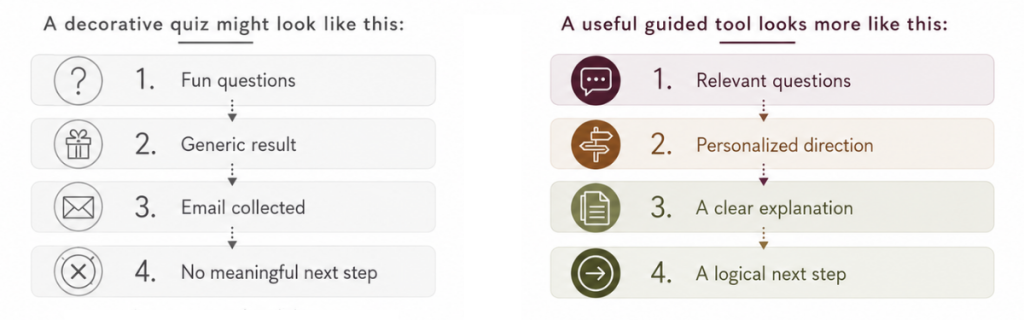
A decorative quiz and a useful lead tool are not the same thing
The difference is whether the experience has a real job to do.
The difference is not whether the tool is technically called a quiz.
A decorative quiz might look like this:
Fun questions
→ Generic result
→ Email collected
→ No meaningful next step
It may create a few clicks.
It may even get shared.
But it does not necessarily help the visitor or the business move forward.
A useful guided tool looks more like this:
Relevant questions
→ Meaningfully different result
→ Clear explanation
→ Appropriate next step
→ Relevant follow-up
The visitor leaves with a better understanding of what fits, why it fits, and what they can do next. The business receives useful context and a clearer opportunity to follow up appropriately.
Questions to answer before adding a quiz
Before you start writing questions or choosing a quiz platform, work through the strategy first.
Ask:
What do visitors struggle to decide?
Do they need help choosing, diagnosing, preparing, prioritizing, or finding the right recommendation?
What should the quiz help them understand?
The result should solve a specific information or decision problem and leave the visitor with more clarity about what fits, what matters most, or what they should consider next.
Can different answers lead to meaningfully different results?
If every path leads to the same generic recommendation, the quiz may not need to exist.
What happens after the result?
Decide where each type of visitor should go next, what action makes sense from there, and how the result connects to a useful service, resource, follow-up, or next step.
What recommendation can you confidently provide?
The result should be something the business can reasonably support and explain.
What information does the business actually need?
Do not collect details simply because you can. Every question should serve the result, qualification, or follow-up.
Does the quiz support an existing service pathway?
The tool should fit into the business and connect naturally to your services, resources, or next steps.
What outcomes will you measure?
Decide which actions or improvements would show that the quiz is helping the visitor and the business.
How will you know whether it is working?
A quiz can look polished and still fail to improve the path.
Strategy matters more than the software.
Useful measures might include:
- Quiz starts
- Completion rate
- Result distribution
- Email opt-ins
- Clicks to recommended pages
- Inquiries
- Bookings
- Lead quality
- Replies to follow-up emails
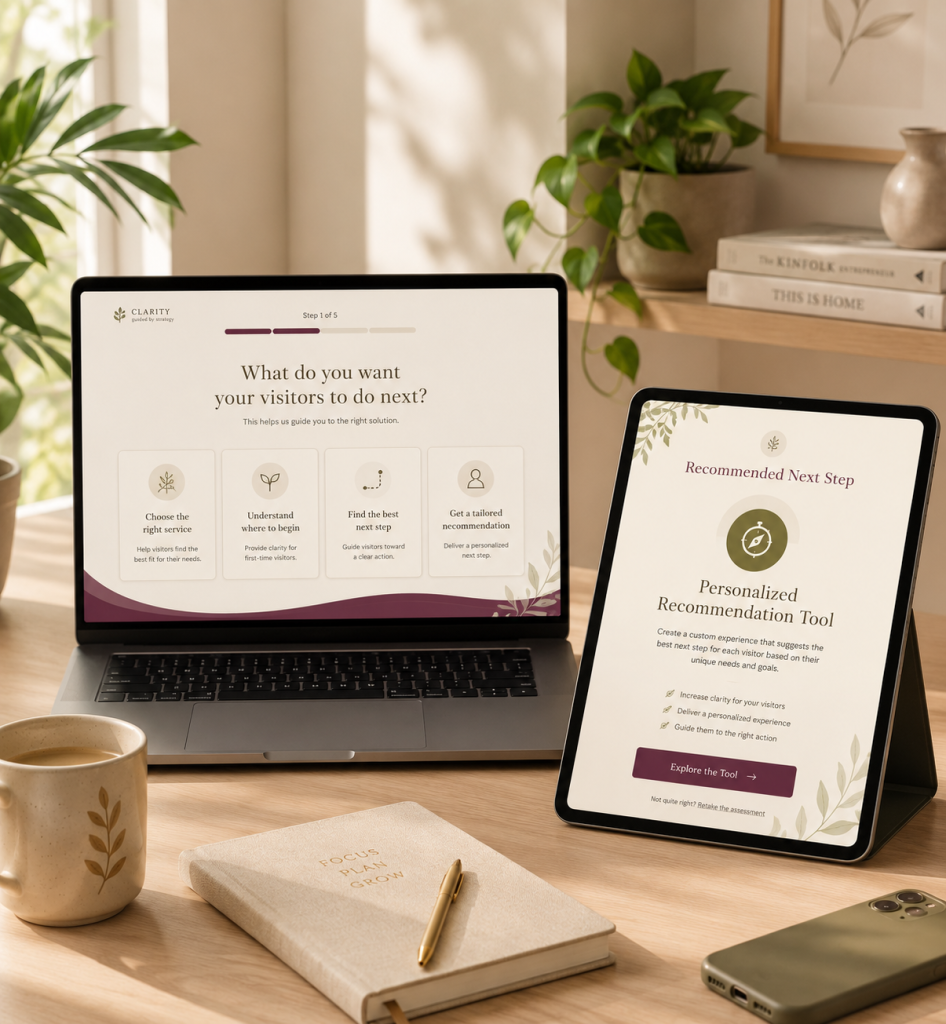
So, should you add a quiz to your website?
A quiz may fit when visitors need help
- Choosing
- Diagnosing
- Assessing readiness
- Clarifying priorities
- Receiving a recommendation
- Finding the next step
It may not be the first move when
- Services are unclear
- The audience is unclear
- Results would be generic
- The follow-up path is missing
- Relevant traffic is extremely limited
The best website quizzes do not exist simply to keep people clicking. They help the right visitor leave with more clarity than they had when they arrived.
It may also help your business collect better context, reduce repetitive early questions, personalize follow-up, and receive more useful inquiries.
But a quiz is not automatically the answer.
It may not be the right first move when your services, audience, results, or follow-up path are still unclear.
Written by Jenni Lynn, founder of Wild Root Web, where she helps service-based businesses create clearer website paths and better-qualified inquiries.
Frequently asked questions about website quizzes
Find the right kind of guided tool for your website
If you are considering a quiz but are not sure what kind would actually be useful, the Find My Best-Fit Tool assessment can help you explore whether a Service Match Tool, Diagnostic Assessment, Readiness Assessment, or Personalized Recommendation Tool makes the most sense for your business.
And if you would rather talk through your visitors, services, result ideas, and follow-up path together, you can request a Tool Fit Session instead.
Explore which kind of interactive lead tool may fit your business.
Talk through your website, services, and visitor pathway.
Get help with the website or supporting pages that may need attention first.